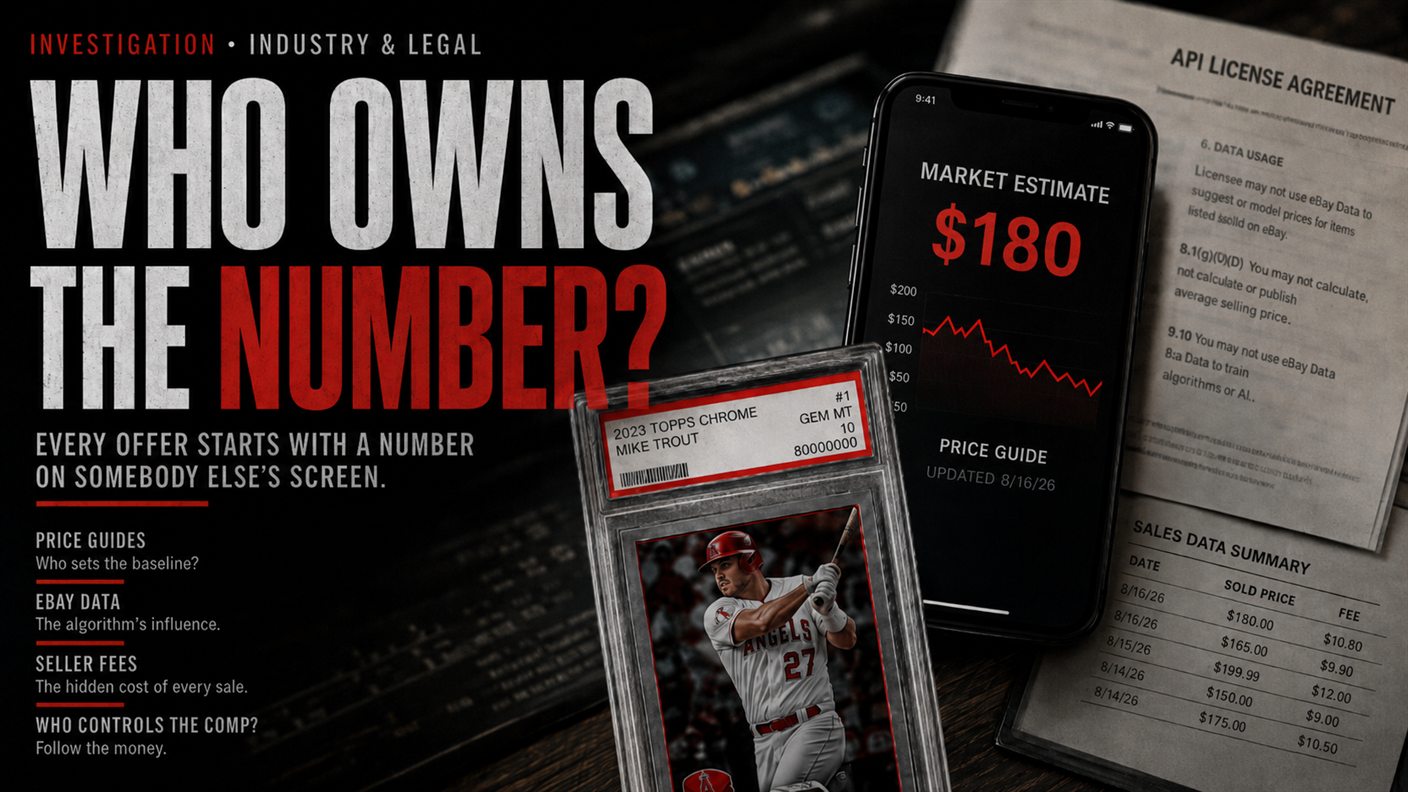
Every offer you get on a card comes from a number on somebody's screen. Here is who controls that number, and why almost nobody is allowed to tell you.
You hand a card across the table at a show. The dealer scans it, glances at his phone, and offers you $180.
Where did $180 come from?
He did not make it up. He read it off a price guide app. That app pulled it from a database. That database was built from sales that happened on eBay, mostly, and then packaged and sold back to him as a product.
The dealer sees a number. You see a number. Neither of you built it.
So here is a question worth asking: who decides what that number says?
It gets stranger. On Fanatics Collect, that company's estimate does not just inform your listing. It sets your seller fee. Price your card above their number and you pay double.
And when we asked four companies to explain how any of this works, we found something that explains the silence in this hobby better than anything else we have seen: eBay's own contract makes it a breach for most of these companies to talk about it at all.
Here is what that costs you, in the order it hits your wallet.
Why you should care
Your offers are anchored to a number you cannot check. Every dealer, every shop, every online buyer is working from the same handful of databases. If those databases are wrong, or slanted, or just stale, you eat the difference on every card you sell.
Nobody outside those companies can audit the math. Not a rival company, not a reporter, not you. eBay has closed off the data legally, and we will show you the exact clauses.
Your sales built the whole thing. Every comp in every database came from somebody consigning a card, paying the fees, and shipping it. That transaction becomes a data point, the data point becomes a product, and the product gets sold to the guy making you an offer.
The people who could explain it are contractually gagged. Not figuratively. There is a clause.
Part One: The contract nobody reads
Almost every price you see traces back to eBay, because that is where the sales happen. Card Ladder's own tracking put eBay above $300 million in a single month out of roughly $421 million across every platform it follows.
To get that sales data legally, a company signs eBay's Terms of Use and API License Agreement. The current version is dated September 3, 2025. It is public, and it runs 58 pages. One of One Interviews captured the whole thing on August 14, 2026, and the full document is posted alongside this article.
eBay Developers Program Terms of Use and API License Agreement, version dated September 3, 2025, captured in full on August 14, 2026.
Almost nobody in this hobby has read it. Here is what is in it.
Two of the restrictions below carry an explicit escape hatch: the contract itself says eBay can grant written permission to do the prohibited thing. The others sit under Section 9, which opens by saying developers may not undermine eBay's business interests without eBay's prior written consent, then lists the specific bans as examples. On a plain reading, that consent language covers the list. Either way, the effect is the same. These are defaults, and eBay decides privately who gets an exception.
You are not allowed to build a price guide. Section 9.5 says developers cannot use eBay data, by itself or mixed with anything else, to suggest or model prices for items listed on eBay.
That is a price guide. The contract prohibits it.
You are not allowed to publish market averages. Section 8.1(d)(1)(D) says working out the average selling price or gross merchandise sold for any eBay category requires eBay's express prior written permission.
That is a market index. Also prohibited.
You are not allowed to resell the data. Section 8.5(b)(4) says data from eBay's Restricted APIs cannot be handed off in bulk or piped out through your own API.
Restricted APIs are the ones that matter here, and we will come back to what eBay means by that term.
You are not allowed to feed it to AI. Section 9.10 bans using eBay data, including personal information, to train algorithms, run machine learning, build synthetic data sets, or train artificial intelligence systems.
Part Two: What permission actually costs
Exceptions exist. Section 8.5(c) lays out the price.
A company can build pricing tools on Restricted APIs data if eBay gives express prior written consent. In exchange, that company grants eBay and its affiliates a non-exclusive, transferable, sublicensable, royalty-free, irrevocable, worldwide license to access, run, publicly display, redistribute, reproduce, modify, host, and store the tool they built.
The same section lets eBay use the tool's outputs in its own marketing and advertising, and lets eBay fold those outputs into eBay's own pricing tools.
Put plainly: you can build on eBay's data, but eBay gets your finished product for free, cannot be made to give it back, and can put it inside their own competing tool. Section 8.5(d) confirms nothing stops eBay from building a rival to whatever you made.
Two more lines in that section are worth sitting with.
Section 8.5(c)(3) requires companies to promise that if they used scraped data in their pricing tools, they did not step on anyone's rights doing it. eBay wrote a clause that, on a plain reading, anticipates its own licensees scraping.
The same subsection requires those companies to warrant that their tools comply with FTC regulatory requirements on deceptive pricing. eBay contractually anticipated deceptive-pricing exposure in the tools built on its data. Keep that one in mind for Part Seven.
Part Three: The gag clause
Section 18 is titled Publicity. Without eBay's written approval, a company in the Developers Program cannot issue any public statement concerning any aspect of that Program. The same paragraph gives eBay the right to make public statements about them.
Read that again, because it reframes everything.
So when a price guide company gives you a vague non-answer about where their numbers come from, that may not be evasion. It may be the contract.
One caveat, and it matters later: Section 18 binds Developers Program participants. A company operating under a separately negotiated commercial agreement with eBay would be bound by whatever that contract says instead, and those contracts are not public either. The gag explains a lot of the silence in this hobby. It does not automatically explain any one company's.
Part Four: The kill switch
Section 16.2 says eBay can suspend access, end the agreement, or cut a company off for any reason or no reason, at any time, without notice, and without owing anything.
Section 16.3 says that when that happens, the company must stop immediately, destroy every copy of eBay data it holds within ten days, and certify the destruction in writing if eBay asks for it.
No wind-down. No grandfathering. Every collector app running on trial or provisional access right now is operating on those terms. One email from eBay and the data is gone.
Part Five: The door is already shut
Getting access at all is close to impossible for anyone small, and eBay wrote that into the contract itself.
The definitions section creates a category called Restricted APIs: the eBay interfaces that provide information about market trends, pricing strategies, sales volumes, and user behavior. The agreement states plainly that access is specially granted to select developers.
That is the entire pricing layer of this hobby, defined as a walled garden in eBay's own terms, with entry by invitation.
The history matches. In October 2020, eBay shut off the tool developers had used to pull sold listings and pointed them to a replacement called Marketplace Insights. The older tools were fully retired on February 5, 2025.
Marketplace Insights is what eBay calls a Limited Release, meaning only companies its business teams approve can use it. It only reaches back 90 days.
And buried in the documentation is this: the API does not cover all eBay categories, and each partner's allowed categories have to be vetted and whitelisted individually.
Approval is not blanket. It is granted category by category, at eBay's discretion. Trading cards is a category. Somewhere inside eBay is a list of who is allowed to see card sales data, and that list has never been made public.
You can watch developers hit the wall in real time on eBay's own forums. One building a card app wrote in December 2025 that his requests returned errors on the first call and that Marketplace Insights was refused as limited to approved partners, leaving no legitimate route to sold comps even though that same data is fully visible in eBay's consumer app. Another replied that he applied and never heard back. A third was told access is no longer given except to major partners.
Meanwhile eBay's user agreement bans scrapers and data mining without permission, with language expanded in February 2026 to name AI bots specifically.
Then, in November 2025, eBay launched its own card price guide inside its app. Two years of its own sold data, accepted Best Offer prices included, updated within 24 hours, PSA population data attached. Free. No limits.
Part Six: Follow who owns what
Now the other half.
Card Ladder launched in June 2020. In December 2021, Collectors Universe bought it. Collectors is the parent company of PSA. At the time, Collectors said Card Ladder would stay agnostic when it came to data sources, grading companies, and pricing.
Collectors has since bought SGC and Beckett too.
Here is what this piece cannot tell you: how Card Ladder obtains eBay sales data. We asked. Nobody answered. Card Ladder has never publicly described the arrangement, and no agreement between Card Ladder, Collectors, and eBay has been made public.
There are several possibilities. A written exception under Section 8.5(c), which would mean eBay holds an irrevocable license to Card Ladder's outputs. A separate negotiated commercial contract that never touches the Developers Program terms at all, which is how large partners typically operate. Or something else entirely.
What is not in dispute is that the terms every public developer signs prohibit building the exact product Card Ladder sells, and that when asked which of those doors they came through, neither company said anything.
On January 28, 2026, eBay started showing the Card Ladder Index inside its own price guide, next to PSA and CGC population reports.
Fanatics Collect went further. Its app release notes tell users that guide prices now show their source, so a collector can see whether a price came from Card Ladder sales data, the platform's own catalog value, a manual appraisal, or nothing yet.
But displaying the number is the small part. Fanatics Collect's help center spells out the seller fee structure: list below 120 percent of market value, as provided by Card Ladder, and you pay a 6 percent seller fee. List at or above it and you pay 12 percent.
So the company that grades your card owns the company whose estimate decides what you pay to sell it, on a marketplace competing directly with eBay, where that same company's index is also on display.
Part Seven: This is already in front of the government
In December 2025, Congressman Pat Ryan wrote to the Federal Trade Commission asking for an investigation into Collectors. He wrote that the company controls grading capacity and pricing analytics through CardLadder while also buying and selling graded cards, which he argued creates severe conflicts of interest. He called grading essential market infrastructure and noted that one grade point can move value by tens of thousands of dollars.
Ryan's letter is a request, not a finding. The FTC has not announced an investigation.
Worth noting what eBay already put in writing. Its own contract makes licensed developers warrant that their pricing tools comply with the FTC's deceptive pricing rules. The platform supplying the data anticipated that exposure before a congressman put it in a letter.
Two lawsuits are also moving, and they cover different ground.
Rasmussen v. Collectors Holdings, filed April 2026 in California federal court, case number 8:26-cv-00897, is about grading. It alleges Collectors used its purchases of SGC and Beckett to lock up the grading market, raising prices and stretching turnaround times. Collectors has asked the court to throw it out or send it to arbitration. Both motions are set for hearing September 11, 2026 before Judge John W. Holcomb.
A separate 188-page complaint, filed July 28, 2026 in Maryland federal court by a collector named Nicholas Funk, goes after the grading process itself. Among its claims: that Collectors owns businesses spanning vault storage, pricing tools, and marketplaces, and that the resulting conflicts are not properly disclosed to customers.
None of it has been proven. PSA has not responded to the Funk complaint.
Part Eight: What happened when we asked
On August 8, 2026, we sent detailed written questions to all four companies, each with a one-week deadline to respond. That deadline passed on August 15.
Collectors. We asked whether the 2021 promise to stay agnostic still holds now that they own SGC and Beckett, how Card Ladder obtains eBay sales data, whether the eBay and Fanatics deals are comparable, and what separates Card Ladder's pricing staff from PSA's population data.
There was no obvious place to send it. Collectors.com has four links: Leadership, Values, News, Careers. The News page just links to coverage written elsewhere. PSA's own press URL redirects there. No media contact, no general inquiry address, nothing. We used the last two addresses the company published publicly, on a May 2024 press release.
No response.
eBay. We asked whether trading cards is a whitelisted category for any pricing company and which ones hold that access, whether any independent developer has a path in, whether the Card Ladder Index deal is paid, and whether eBay sees a conflict in displaying a valuation from the company that grades the cards.
No response.
Card Hedge. We asked where its sales data comes from, how much of it is eBay, and how it obtains that data. Its own site names eight sources: eBay, Fanatics, Heritage, and Goldin for sales, and PSA, SGC, BGS, and CGC for population data. Not one of those companies publishes an open feed. The word "licensed" does not appear on that page. Its API sells cert-level price lookups to anonymous AI agents for about a penny a call, with no signup and no key required.
No response.
Fanatics answered, and the answer became its own story.
An automated acknowledgment arrived August 8 with a case number. On August 9, a named representative from Collector Experience at Fanatics Live and Collect replied. She confirmed she understood we were asking about Fanatics Collect's pricing data, its use of Card Ladder data, its relationship with Collectors, and how pricing is sourced on the platform.
Then she said those questions were too specific for Customer Support and recommended we contact the Sales team.
We emailed the Sales team the same day with the same questions. That address has not responded either. The deadline came and went.
What this all adds up to
Under eBay's own posted terms, building a card price guide is prohibited. Publishing market averages is prohibited. Reselling Restricted APIs data is prohibited. Feeding it to AI is prohibited.
Every one of those prohibitions is a default that eBay can lift in private. Exceptions get handed out on terms that give eBay an irrevocable free license to whatever gets built. And the companies inside the Program are contractually forbidden from talking about it.
Inside that closed system, the company that grades your cards supplies the price data to eBay and to eBay's biggest competitor, where its estimate sets what you pay to sell. A congressman has asked the FTC to look at exactly that. Two federal lawsuits are pending.
And every number in the chain started as a card that somebody consigned, paid fees on, and shipped.
Back to the guy at the show offering you $180. He is not the problem. He is reading a screen, same as you would. The question is who built what is on that screen, what they were allowed to build it from, and why not one of them will say so out loud.
Four questions still unanswered
Which companies hold eBay whitelist access for trading cards? One sentence from eBay separates the licensed operators from everyone else. Every price guide charging you a subscription should be able to answer yes or no.
Is Card Ladder's arrangement a written exception under Section 8.5(c)? If it is, eBay holds an irrevocable license to Card Ladder's outputs. A one-sentence answer from either company settles it.
Does Fanatics pay Collectors, and on what terms? Fanatics competes with an eBay that displays the same index. A contract exists somewhere. Nobody has seen it.
Who pays the seller when the number is wrong? Nobody. That is the one part of this that is not complicated at all.
One of One Interviews sent detailed written questions to Collectors, eBay, Card Hedge, and Fanatics on August 8, 2026, with a one-week deadline to respond. That deadline passed on August 15. Fanatics Collect acknowledged the inquiry and on August 9 redirected it to a sales address, which was contacted the same day and has not responded. Collectors, eBay, and Card Hedge did not respond. This piece will be updated with any response received.
The eBay Developers Program Terms of Use and API License Agreement cited here is the version dated September 3, 2025, captured in full on August 14, 2026 and published alongside this article. Corrections or documents: steven@oneofoneinterviews.com