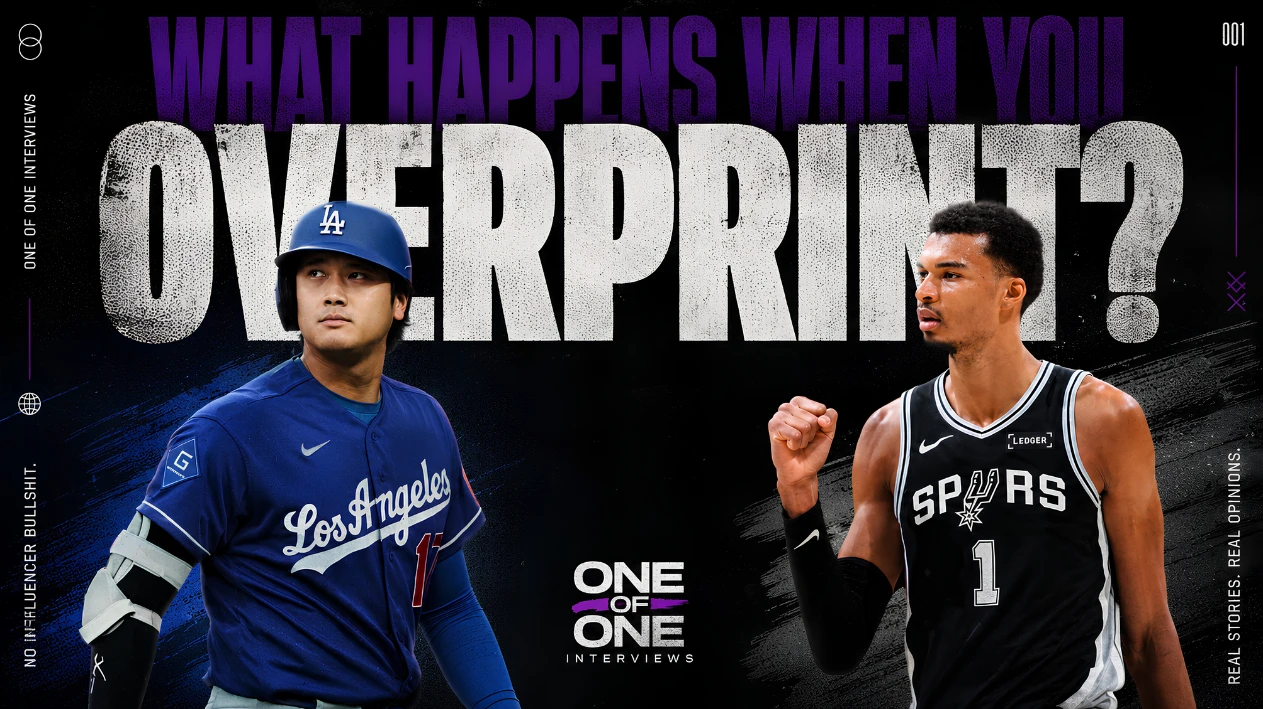
I was talking with my buddy and one of my favorite Facebook card movers, Ian Mcwhorter, the other night. He brought up a good point, and something we seem to talk about and then just glaze right over: Ohtani and Wemby's card numbers are going to dramatically affect collecting down the road.
He's right. But after publishing the first version of this piece and getting absolutely lit up in the comments by people who know their stuff, I have to tell you something up front: the headline question is the wrong question.
Overprinting isn't what's happening here. What's happening is worse, and it doesn't have a catchy name.
First, What This Is Not
Panini is not printing extra Wembanyama cards. His base Prizm rookie has the same print run as every other rookie in that set. Topps is not running secret overtime on Ohtani. And junk wax print runs absolutely dwarf anything printed today. The 1989 Upper Deck Griffey ran into the millions. No modern base card comes close.
So if you define overprinting as "more cardboard exists now than before," the answer is flatly no. That case is closed and I was sloppy the first time I made it.
Here's the thing though. Print run stopped being the number that matters.
The Number That Actually Matters
The tradeable unit in the modern hobby is not the card. It's the slab. Raw copies don't set the market on a card like this, graded copies do, and specifically gem copies. So the supply that determines what your card is worth in twenty years isn't how many were printed. It's how many end up in a PSA 10 holder.
And that number is being manufactured continuously, right now, by us.
Look at that Ohtani gem rate again. 84 percent. Five out of every six copies submitted come back gem mint. That is not a knock on Topps, it's the opposite, the card is manufactured beautifully. But it means the conversion rate from raw copy to gem copy is nearly frictionless. Every submission wave becomes gems.
Now compare that to the card everybody uses as the cautionary tale. Millions of 1989 Griffeys exist. Depending on which tracker you pull, somewhere between 90,000 and 130,000 have been graded, and the PSA 10 count is still sitting right around 4,200. Millions printed. Roughly four thousand gems.
Why? Because that pool spent almost four decades getting handled, rubber banded, and stuffed in shoeboxes. The raw supply degraded below gem quality. Griffey's gem population is effectively frozen no matter how many copies exist.
That is the actual story. Not print runs. Preservation plus grading access plus demand, running on a loop that has no off switch.
The Machine Behind It
PSA processed 2.17 million cards in a single month earlier this year, and topped 2.5 million in June. That's the run rate, not a spike. And these two players sit at the front of the line. Per GemRate, Wembanyama had 547,609 total graded cards as of last October, two seasons into his career. PSA alone graded roughly 407,000 of his cards in 2024, about 138,000 more than second place Michael Jordan.

Here's the part that makes it self-reinforcing. Demand is what creates this supply. Global reach is exactly why Ohtani and Wemby specifically. The Japanese market, the French market, worldwide appeal, biggest prospect in a generation. That attention drives submissions, submissions become gems, and gems never leave the pool. The more people want the card, the more copies of it get manufactured in slab form.
Demand doesn't drain this supply. Demand builds it.
And Then There Are the Parallels
Every time this conversation comes up, somebody points out that numbered cards are scarce, as if that settles it. It doesn't, because a numbered parallel doesn't replace the base card. It stacks on top of it.
Take one card. Ohtani's 2018 Topps Chrome rookie, the single most recognized card he has.
- Purple /299
- Blue /150
- Green /99
- Green Wave /99
- Blue Wave /75
- Gold /50
- Gold Wave /50
- Orange /25
- Red /5
- Red Wave /5
- Printing Plates (4)
- Superfractor 1/1
And that's before the unnumbered Refractors, Prisms, Negatives, Pinks, Sepias and Xfactors stacked on top. Ohtani appears in over 440 different sets according to Sports Card Investor, many running similar ladders.
Wemby's the same structure. Topps Mercury, an all-Wemby product with a 20-card checklist, runs /99, /75, /75, /50, /45, /35, /25, /15 and down to a 1/1 on every single card. That's over 400 numbered copies per card, more than 8,000 serial numbered Wembys out of one product. Sports Card Investor is already tracking close to 8,000 distinct Wemby cards total, two seasons in.
A /299 isn't scarcity. It's 299 more cards.
So What Does This Do Long Term
The flagship graded rookie stops being a collectible and becomes a unit of exchange. When 26,000 PSA 10s of one card exist and the number climbs every quarter, nobody is holding a rare object. They're holding something liquid and easily replaced that happens to have a superstar's face on it. That's not worthless, liquidity has real value, but it's not the appreciation story people think they're buying.
Scarcity migrates to the low-pop tiers. Wemby's Red Prizm, numbered to 299, has only 163 PSA 10s. That's where the actual chase lives now, and it's a much smaller room than the one most collectors are standing in.
And twenty years out, the graded rookie of a genuine Hall of Famer could underperform badly on population math alone. Not because the player busted. Because the gem pool never stopped growing while everybody assumed the slab was the scarce thing.
Nobody upstream is incentivized to slow this down. Grading companies get paid on volume. Manufacturers get paid on parallels. Both of those businesses work better when more cards exist in more tiers, and neither one is responsible for what the population report looks like in 2046.
The Bottom Line
Ohtani and Wemby earned every bit of the attention. Two-way dominance and a 7'4" unicorn are not manufactured stories. But talent doesn't cap a submission queue, and the thing collectors are actually buying, the gem population, is being built larger every single month by the same enthusiasm that makes the cards desirable in the first place.
So no, they're not overprinting. We're over-slabbing. And the pop report doesn't care which word you use.
The first version of this piece framed the story as overprinting and compared modern graded populations to the 1989 Griffey without accounting for era differences in grading access. Both framings were wrong and this version corrects them. It also fixes an error identifying Ohtani's second rookie card, which is the 2018 Topps flagship #700, not Topps Update.
Thanks to William Ryan Wundrach for the pushback that forced the rewrite. Population figures cited here come from GemRate, Card Ladder, Sports Card Investor, and Beckett checklists, and reflect the most recent public snapshots available at publication. Pop reports move daily. These numbers will be higher by the time you read this, which is rather the point.