 One of One Interviews
I Stole a Comic Book Cover Wednesday Night
The debate over AI art keeps asking whether the tool is cheating. After twenty minutes with it, I think that is the wrong question.
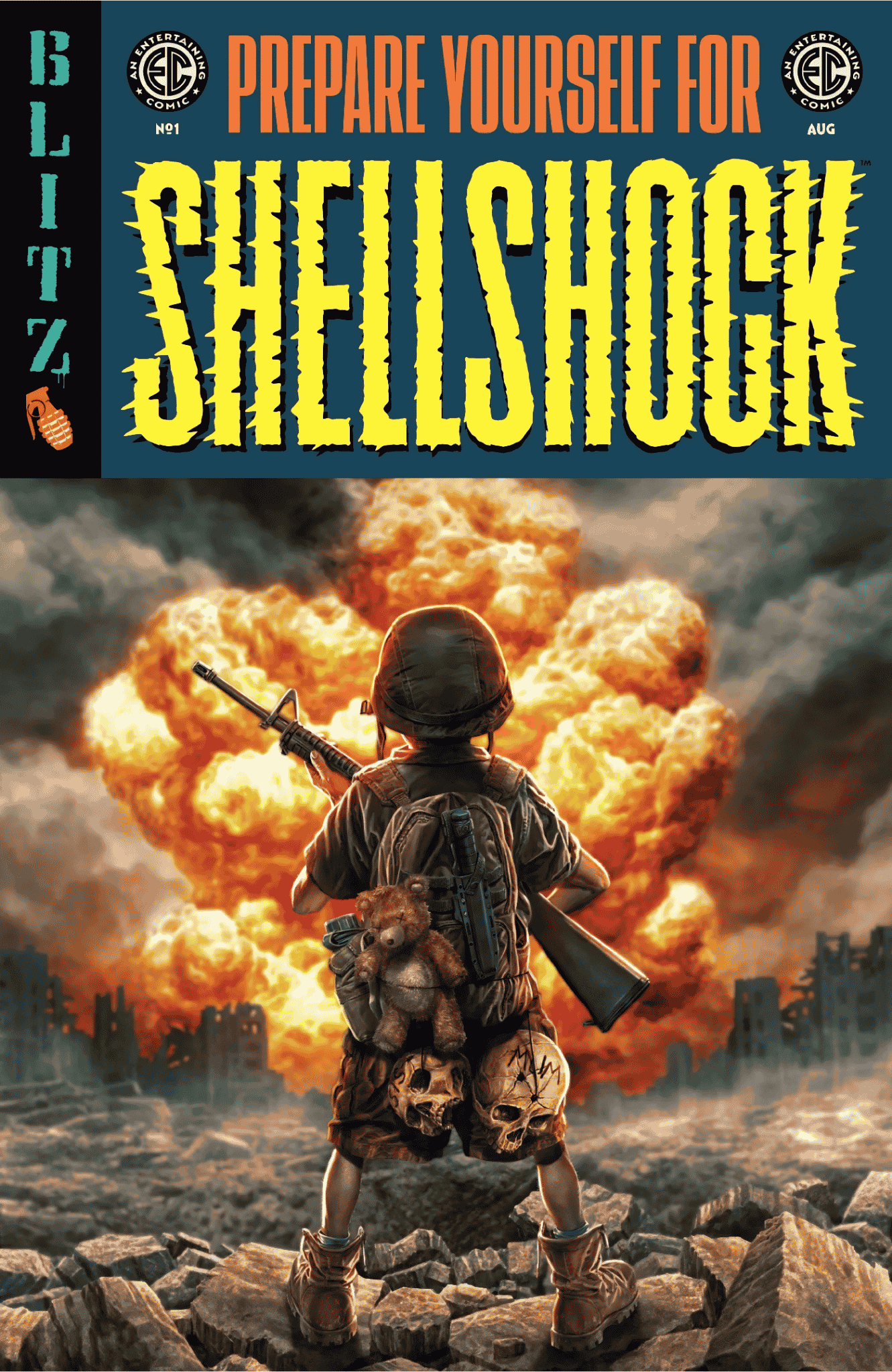
Wednesday night I was watching Beyond Wednesdays, which I will argue with anybody is the best live show on the internet in any genre. They put up the Lee Bermejo cover for EC Shellshock #1, which had just hit shops that morning, and I stopped what I was doing.
Here is the image. A kid stands with his back to you on a field of broken rock. The helmet is three sizes too big. He is holding a rifle the way a child holds a stick he found in the yard. Combat boots, cargo shorts, a teddy bear lashed to his pack, two human skulls swinging off his belt. In front of him, filling the entire frame, an orange fireball the size of a city block. He is not running from it. He is just standing there looking at it.
I said something out loud at my kitchen table. I do not remember what.
Then I opened an image generator and made my own version of it.
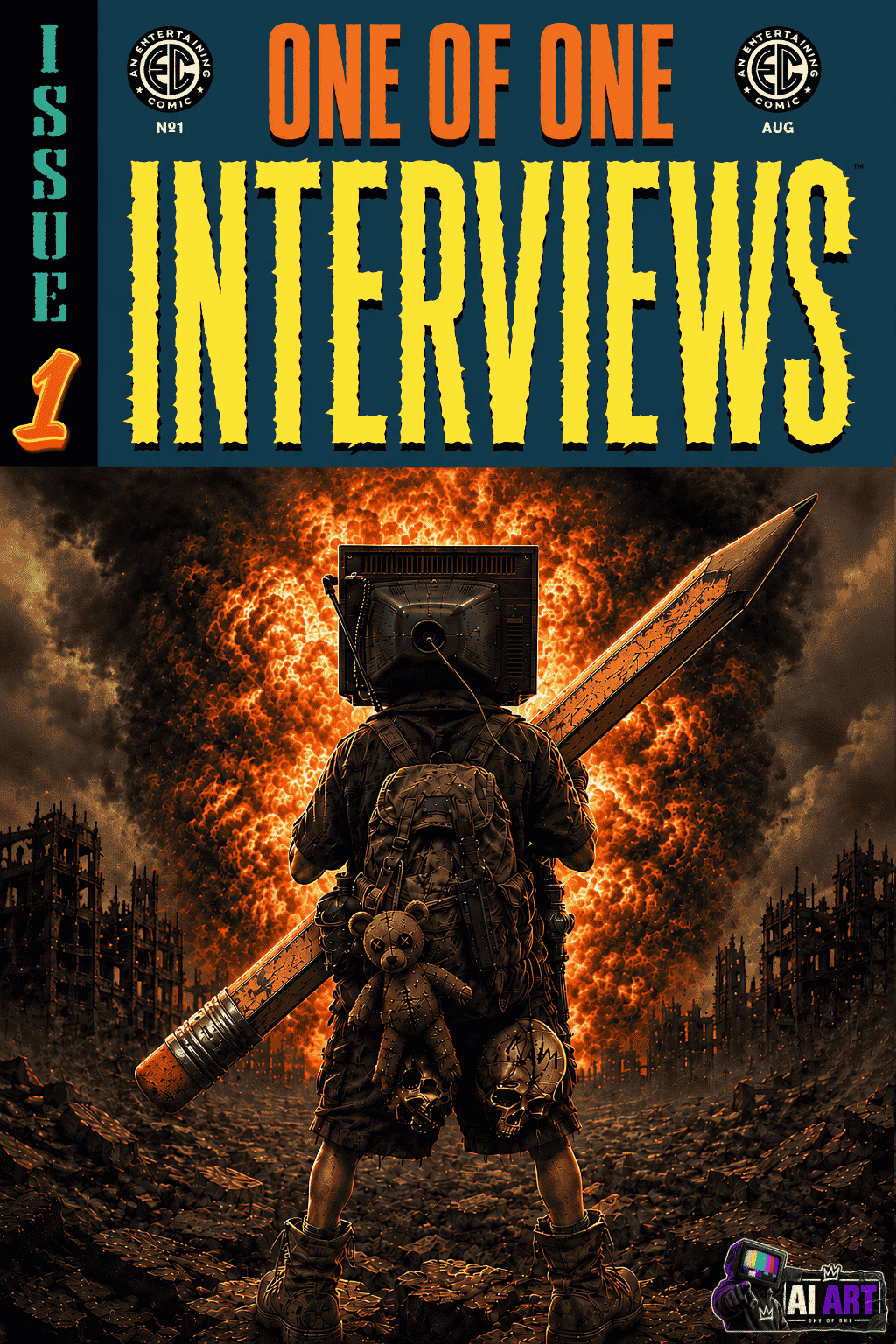
Twenty minutes later, thirty at the outside, I had a cover with my logo on it. Same kid, same stance, same fireball, same ruined skyline, same skulls on the belt. I swapped a few things. My character has an old CRT television for a head. The teddy bear became a voodoo doll. And the rifle became a giant number two pencil with the eraser worn down, carried across the body the exact way the kid carries the rifle.
I looked at it and felt like I had made something.
The next morning I looked at it again and understood what I had actually done.
The line item
Break it down honestly and my contribution is short.
The pencil is mine. That one is a real idea. A guy who covers an industry that would prefer not to be covered, walking into the blast with a pencil instead of a rifle, is a thing I actually meant. The television head is mine. The voodoo doll is mine, and it means something specific if you know who I have written about.
Everything else in that picture belongs to Lee Bermejo. The composition. The back turned to the viewer. The scale of the fireball against the size of the kid. The decision to put the horror behind him and the innocence on him. The color. The silence of it. People will tell you Bermejo started at WildStorm as a teenage intern in the late nineties. He does not say that in the interview I am citing here, so take it as the story that gets repeated rather than as something I confirmed. What is not in question is that he was there, and that he has been building images like that one ever since. Whatever it took him to learn how to do that to a person's chest, it was not twenty minutes.
I did not have an idea I lacked the skill to execute. I had his idea, and a machine executed it for me.
That matters, because the argument I hear most often for this technology is that it lets people with real ideas and no training finally get those ideas onto the page. I believe that argument. I am the guy it describes. I am a firefighter and a paramedic who taught himself to write, edit video, and build a website because nobody was going to hand me any of it. If there is a case for opening the gate, I am standing in the doorway making it.
But my cover is not evidence for that case. It is evidence for the other one.
What the industry is actually fighting about
The comics world has been at war over this for years, and the war got more formal this year.
For a while, San Diego Comic-Con ran a compromise. AI work could hang in the Comic-Con Art Show as long as it was labeled and not for sale, and if you had prompted it in the style of a specific artist, you had to say so. In January, after artists went public against the policy, the convention scrapped the compromise and banned the stuff outright. The rules now say material created by AI, in part or in whole, is not allowed in the art show, and the art show coordinator is the sole judge. Emerald City Comic Con has its own ban on selling AI-generated work, and Forbes reported in April that attendees walking the artist alley in Seattle were still stopping at booths and wondering.
That is the part that should scare people. The comics journalist Rob Salkowitz laid out the trap in that same Forbes piece: detection tools can be beaten by cropping, tracing, or blending real and generated art, and they also flag human work that happens to look like the models trained on it. Which means the artists whose styles got scraped hardest are the ones most likely to be accused of faking. Salkowitz points at a case where a company that makes art software for comics shipped a new edition, and the promotional image on it set off days of argument about whether a human had drawn it or traced it over an AI render. This is a company that had already stripped the AI features out of its own product years earlier because users complained. The artist said flatly that he drew it by hand and posted a speed paint of himself drawing it, and the suspicion still did not fully go away. Having to prove you drew your own work is now part of the job.
One creator is trying a different approach. In April, Matt Kindt launched a "100% Human-Made" certification logo through his FLUX HOUSE imprint and put it out under a Creative Commons license for any creator to use. It runs on the honor system, and Kindt has said plainly that is the point. It is not a detector. It is a signature. It debuted in a book from Oni Press, the same publisher that put the Bermejo cover on my screen Wednesday night.
The card hobby version
We have been through our own round of this. A dual Downtown insert of Bijan Robinson and Michael Penix Jr. from 2024 Panini Donruss Football set off a fight on X, and my circle tore into that card right along with everybody else. The field behind the players had yard markers running the wrong direction. The Nike logo was reversed on both of their shoulders. One of Penix's cleats had a backwards logo on it. For a week you could not scroll past it. Panini has never said what made that image, and I am not going to say either. But every collector I know had already decided.
Sports Illustrated's collectibles desk covered it, and the useful part of that coverage still holds up. The complaint was never really that a machine was involved. The complaint was that nobody with eyes looked at the thing before it went into a pack somebody paid for.
Now flip it. Adobe published a case study in January on Fanatics Collectibles running its Topps Now digital line through Firefly Services. Read the details and it is not a robot painting cards. It is background removal, cropping, masking, and banner assembly, the thousands of repetitions that used to eat weeks. Fanatics says turnaround dropped from weeks to hours and its designers got back more than sixty percent of their time. Their vice president of Topps Digital says the crew used that time to try things they never had room to try, including new art styles.
It is Adobe's own marketing, so take the numbers as the company's numbers. But the shape of it is honest, and it is the strongest version of the argument. Nobody's soul lives in masking out a background thirty thousand times.
Both of those stories are true at once. That is the whole problem.
The better question
Nobody hands out a certificate for how you made it. In an interview back in 2009, long before any of this was an argument, Lee Bermejo said he was self-taught and never had much formal art training, and that WildStorm was as close as he got to an art program because he was surrounded by artists his own age who taught each other. The gates in this business were never guarded by credentials. They were guarded by whether you had something to say and the stubbornness to keep saying it until somebody looked.
So the question is not whether the tool is cheating. The question is what you brought to it.
Did you have something before you opened the app? A point, a grudge, a joke, a thing you noticed that nobody else noticed? Or did you see something somebody else made, feel the feeling it gave you, and then ask a machine to give you the feeling with your name on it?
That is an uncomfortable test because it does not let you off with a rule. There is no software setting that passes it. You have to answer it yourself, every time, and you will sometimes answer it badly.
I answered it badly Wednesday night and pretty well on the pencil.
Why collectors should care most of all
Everything we buy in this hobby runs on provenance. Who made it, when, how many, and can you prove it. That is the entire machine. A card is a piece of cardboard until the chain of custody makes it something else.
Art is about to be the same fight. The image on the cover of your favorite comic book, the insert in your top loader, the thumbnail on the video you clicked. Somebody made those, or something did, and pretty soon the only difference between a collectible and a picture is going to be whether anyone can answer which.
Look at the bottom right corner of my cover. There is a tag on it now that reads AI ART. I put it there myself and nobody asked me to.
I went the invisible route first, the embedded content credentials that are supposed to ride along inside a file and tell you where it came from. This image lost them in an export. That is the trouble with the quiet solution. A mark on the face of the picture survives what metadata does not.
Matt Kindt's stamp says a human made this. Mine says a machine did. Same instinct pointed in opposite directions, and neither one is enforced by anything except whether the person is willing to say so out loud. I would rather be the guy who tells you than the guy who gets caught.
The cover is still on my desktop. I am not going to use it for anything. It is a good picture and it is not mine.